Does Recycling in Utah Really Work? Here’s the Truth About What Happens to Your Trash

Recycling Fact vs. Fiction
We want to clear up a major myth surrounding recycling in Utah. Too often, we’ve heard people wondering what actually happens to the bottle, jar, or can thrown into the recycling bin.
Common Myth: Anything you put in your recycling bin just ends up in the landfill anyway. If it’s all going to the same place, why bother using different bins?
Truth: There are occasional times when items may end up in the landfill. (More on this below!) However, MOST of the time, every item in your recycling bin is sorted and sent to the appropriate refining facilities to create recycled material that manufacturers can use in making their products.
The Longer Answer:
Items from your mixed recycling bin may end up in a landfill if…
- It’s too contaminated (like cardboard covered with broken glass, food, or oil)
- The sorting facility can’t identify it (which can happen with some types of plastics)
- There isn’t an “aftermarket” for the materials
The reality is that recycling is complicated because it’s intertwined with global economics and trade.
Allow us to explain.
First, a little history to understand where this recycling myth may have originated. This one may be particularly persistent because of the way plastic recycling has unfolded.
In the early days of recycling, most of our recycled plastics were bought by other countries like China. They wanted any and all plastics because they would burn this waste instead of oil to fuel their economies. As the USA and Europe bought most of the oil from the Middle East, it was nearly impossible for these other countries to obtain fuel, so the plastic waste was a secondary source to get the fuel they needed.
While our recycled plastics weren’t being recycled in the way most of us may have imagined, they were being repurposed for another use, and it happened this way for years.
Following the September 11 attacks in 2001, there was a significant push for the United States to become energy independent in its oil production. Over the next several years, as domestic oil production ramped up, the US bought less oil internationally, freeing up supply for China and other countries. This significantly dropped the demand from these countries for used plastics internationally, and nearly overnight (ok, it was actually over the course of about 9-12 months) Chinese buyers stopped buying US waste plastics.
This created a big problem because the US didn’t have the infrastructure needed to process the plastic recyclables into usable products. So for a short time, there simply wasn’t anywhere for the sorting facilities to send the plastics that were collected in recycling bins. During this time, there was a decent chance that recycled plastics were ending up in the landfill. However, since then, the industry has evolved, and our domestic capabilities have rapidly expanded.
(To be clear, other recyclables like paper, cardboard, and metal have not faced this same challenge. These materials have been recycled domestically for decades.)
 The Reality of Recycling in 2025
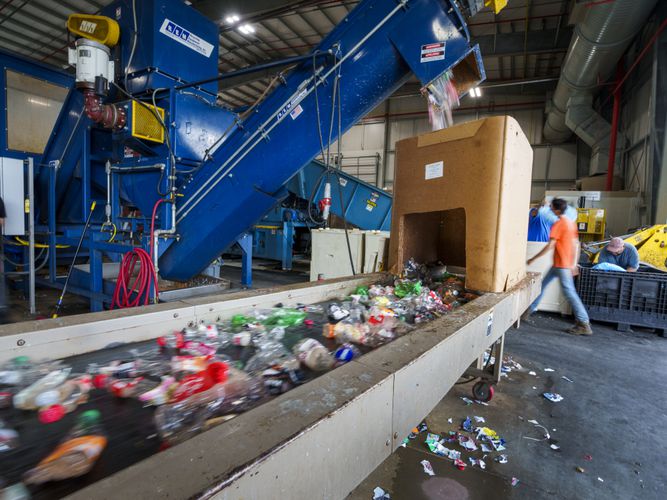
Today, there are many domestic recycling and refining facilities within the United States. To follow the recycling trail, you throw your recyclables into recycling bins and designated drop-off locations, and those items get delivered to a local sorting facility. Once sorted, the items are taken to refining factories, where the old material goes through the necessary process to once again be turned into a usable product. After refinement, the new material is sent to manufacturing facilities to produce the end products.
Many major brands like Coca-Cola, Dell, and Patagonia have transformed the recycling industry by making big moves to incorporate recycled material into their products. To support these efforts, refining factories are often located near the manufacturing plants to make production with recycled material even easier. For instance, the glass Momentum Recycling recycles is turned into fiberglass by our customer in Nephi (Owens Corning), and plastic refineries are typically located near facilities that make plastic bottles, fleece, and carpet.
Within the last 10-15 years, there has been significant investment in improving not only the domestic recycling infrastructure but also the ability to use recycled material in new products. Because we have more end-markets that want recycled products, the domestic processors, or refiners, can accept more material from the landfills.
These are processes we can see even here in our own backyard!
In Utah, these companies are actively refining recycled materials:
Glass (Momentum Recycling)
Utah is home to the only glass recycling factory in the Intermountain West Region. Momentum Recycling has many drop-off locations throughout Utah for those communities where their collection service is not yet available. Glass can be recycled unlimited times and used in the production of new glass bottles and insulation.
Cardboard and Paper (International Paper Recycling, Interwest Paper Recycling)
Both of these recyclers are located in Salt Lake City, and Interwest Paper is one of the first recycling companies in Utah. Recycled cardboard and paper can be refined and used as packaging materials, tissue products, newspapers and magazines, and animal bedding.
Organic and Food Waste (Wasatch Resource Recovery)
Located in North Salt Lake City, this recycler’s goal is to keep food waste from grocery stores, restaurants, and hotels out of the landfills. Recycled organic material and food waste are turned into fertilizer and natural gas.
Scrap Metal, Aluminum, Copper, and Electronics (Western Metals)
With multiple locations throughout northern Utah, Western Metals refines metals that companies like Nucor Steel (another local Utah company) use to make rebar and other products.
What About Plastics?
While there are not currently any companies in Utah that refine recycled plastics, we do actively collect plastics for recycling! Once collected, it’s shipped to various refineries around the country and then to various manufacturers to be turned into products such as carpet, furniture, toys, plastic bottles, and textiles like fleece.
It’s also critical to know that while harder plastics (those marked with the recycle triangle and a number—think a water bottle, milk jug, or detergent bottle) go in your mixed recycling bin, things like plastic bags and plastic wrap must be collected separately. Please don’t ever put plastic bags in the recycling bin! Instead, they should be dropped off in specially marked bins often found at your local grocery store (usually right at the front).
Key Message: Don’t Stop Recycling!
Now that we’ve busted the myth and you know your recyclables DON’T just end up in the landfill along with the other garbage, please keep recycling and putting recyclable materials in the designated recycling bin! If you walk away with one thing, let it be this: If your local recycling program accepts it, then keep putting it in the bin. Trust the system.
Overall, and thankfully, many companies and brands are moving in the direction of improving sustainability, increasing their use of recycled material, and decreasing waste from their products. Recycling will continue to gain momentum as more and more companies join the cause. Together, we CAN make a difference.

 (801) 355-0334
 E-mail us!



Hello!
I am wondering if this article of info can be reposted in our newspaper in Ogden valley (moving into being a new City) with credits to you…and how can we get a glass recycle bin?
I want to help educate our beautiful valley so mute people get recycle bins!
Thank You
Gina385-206-9661
Hi Gina!
You absolutely can repost this article. We love seeing other people who are as excited about recycling as we are, and it helps our communities more than we can say 🥳
Momentum Recycling does already have some glass drop-off locations in the Ogden valley area – check the map here: https://utah.momentumrecycling.com/recycling-services-homes/#dropoff
We hope this helps!